An ID Card for Every Battery, Encouragement for Everything Else
China's new battery recycling rulebook: a digital ID for every retired power battery pack, a licensing purge, and scrapping rules rewritten around the battery.

- Order No. 73, in force since 1 April 2026, gives every power battery a digital ID (Article 12) on a national traceability platform, with collection networks matched to sales volume.
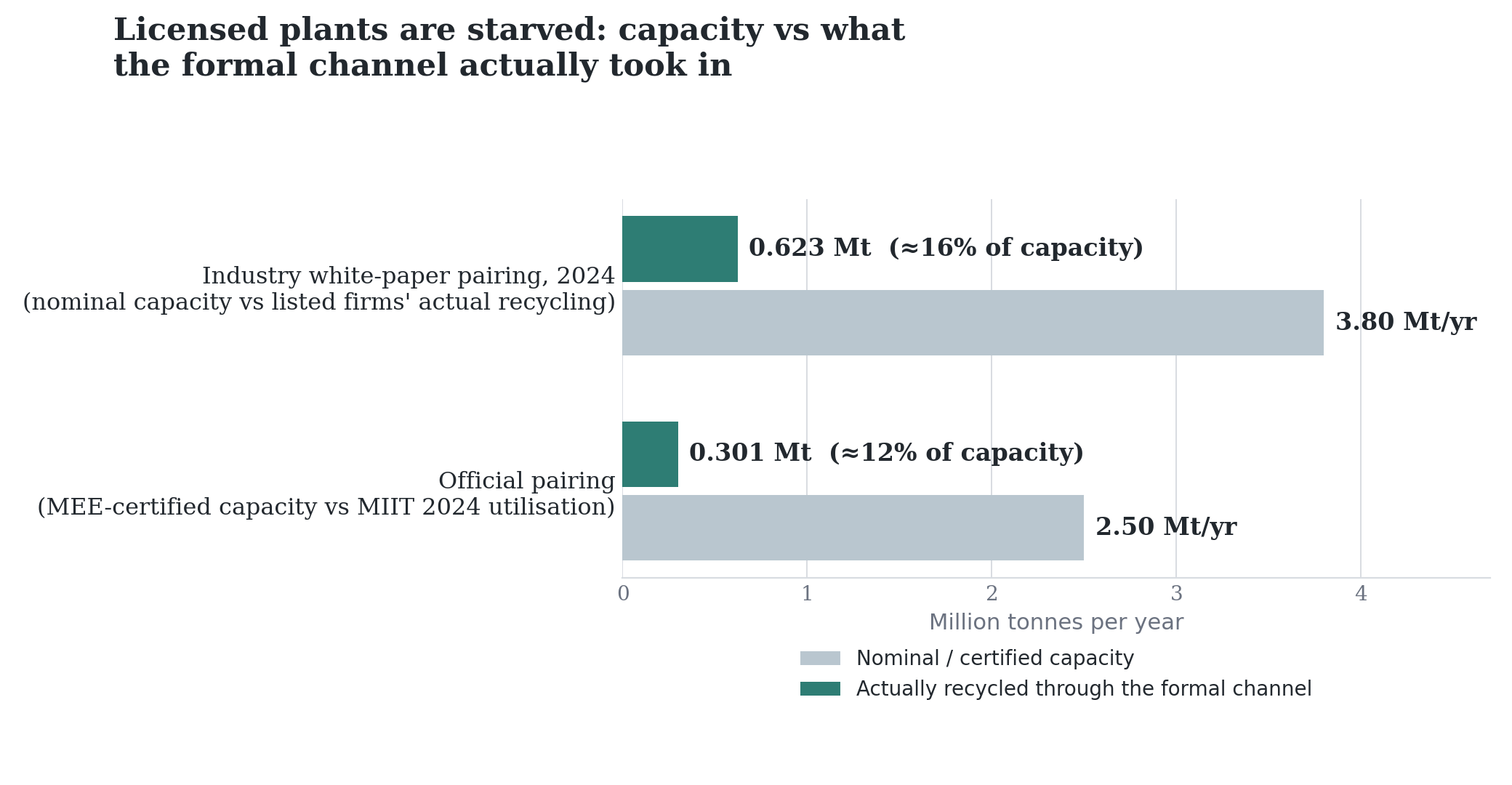
- Formal comprehensive utilization in 2024 was 301,000 tonnes against about 2.5 million tonnes of certified capacity — roughly 12 percent, on WattAnalysis arithmetic — so licensed plants are starved of feedstock.
- For PV modules and wind blades, Document No. 206 merely encourages retirement-recycling systems and defers the binding measure: no fee, deposit, quota or target applies.
China has spent the past year building an unusually detailed rulebook for retired power batteries — a departmental law with a digital ID for every pack, a licensing list from which 100 entries were then struck, and a nine-department plan to rewrite the scrapping rules so new-energy vehicles are scrapped with their batteries attached.
For the solar panels and wind blades retiring alongside them, the same plan offers encouragement. The numbers show why the battery half had to be hard — and why the soft half bets that the wave arrives late.
Q1. What changed at the bottom layer: three instruments, three different hardnesses
Read as one stack, China's "new three" recycling regime — waste power batteries, PV modules and wind turbine blades — was assembled in three moves across late 2025 and 2026, and the moves are not equally binding.
The hard layer is a law that has drawn little coverage. The Interim Measures for the Recycling and Comprehensive Utilization of Waste Power Batteries from New Energy Vehicles — Order No. 73 of six departments (industry, planning, environment, transport, commerce and market regulation), promulgated on 31 December 2025 and in force since 1 April 2026 — is a departmental regulation, not a guidance document.
It establishes a national traceability platform run by the industry ministry to monitor every power battery's flow "from production, sales, maintenance and replacement to dismantling, recycling and comprehensive utilization" (Article 4). It creates a "digital ID" system for power batteries covering product type, composition and end-of-life information (Article 12). It obliges battery makers to run collection networks matching their sales volume in every province where they sell, and vehicle makers to do the same in every prefecture-level city.
It also forbids both from refusing batteries handed in by repairers and battery-swap operators (Articles 14–15). A scrapped new-energy vehicle that arrives without its battery "shall be deemed a vehicle with a part missing" (Article 21). No organization or individual may use a spent power battery, directly or after processing, in an e-bike or any other field prohibited by law or mandatory standards (Article 22).
Violations carry fines — modest ones, imposed only after a correction order is refused, a point we return to — and, more consequentially, a penalized utilization firm is barred from applying for the industry ministry's approved list for two years, and a listed firm is struck off (Article 42).
The second move deleted a category. On 30 July 2026 the industry ministry's Announcement No. 20 abolished "echelon use" — the repurposing of retired EV batteries into lower-duty applications — as a regulated category. The echelon clauses of the 2024 norm conditions were repealed, echelon-use announcement management ended, and every echelon entry was removed from the approved list: the removal attachment runs to exactly 100 entries. A firm holding a separate regeneration entry stays listed — what was deleted was a category, not a population of companies.
The regeneration (materials recovery) list "remains in effect". The ministry did not stop at firms: standards bodies were told to purge echelon-use standards, regulators to purge echelon-use policies, and industry associations to purge the term from their names, events and training.
The Measures themselves had already written the concept out — their definition of comprehensive utilization covers dismantling, crushing, sorting, smelting and similar processing — with no echelon concept anywhere in it. A decade of policy that treated second-life use as the value-maximizing route for a retired pack was closed by deleting the category.
The third move is the one that made headlines, and it is the softest. The nine-department Opinions on recycling-system building (Document No. 206, signed 11 November 2026) give the new three a dedicated section inside a general recycling-system plan. For batteries, the document's one hard instrument is a routing rule: the scrapped-vehicle implementation rules will be revised so that new-energy vehicles are scrapped with their batteries — "vehicle-and-battery integrated scrapping".
Its digital-ID clause, by contrast, commissions officials to "study and formulate" a digital-ID management system and related administrative regulations — a drafting instruction, sitting one level below the Measures, which had already established the system in law while delegating its own operating detail to a future measure. For PV modules and wind blades, the same document asks power generators to be "encouraged" to build retirement-recycling systems, and defers the binding instrument: a management measure for retired blades and modules is to be formulated later.
Producer responsibility, across the whole document, is one general clause: producers are "guided" to build collection systems matching their sales volume. There is no fee, no deposit, no quota and no allocation formula anywhere in the published (abridged) text, and no quantitative target for any of the three waste streams — the document's only dated goal is that by 2030 a recycling system with a sound network is "initially established".
The bottom layer, in other words, moved very unevenly. The battery acquired an identity, a platform, a network obligation and a routing rule. The blade and the panel acquired an encouragement and a promise.
Q2. Where it binds: the feedstock gate, and a measurement problem the state solved by abolition
The stack's binding constraint is not processing capacity. It is the first gate: whether a retired battery physically reaches a licensed firm.
On the environment ministry's own numbers — as stated at its November 2025 briefing and reported by China Daily — China's 148 ministry-certified battery recyclers already held about 2.5 million tonnes a year of capacity. Formal comprehensive utilization in 2024 was 301,000 tonnes (industry ministry figures) — roughly 12% of that capacity, on WattAnalysis arithmetic from the two official inputs (2024 utilization against the capacity figure cited in November 2025; the inputs are from adjacent years).
Association and vendor calibers are wider but tell the same story: the industry white paper's 3.8 million tonnes of nominal capacity against 623,000 tonnes actually recycled by listed firms (utilization below 18%), or Mysteel's survey of 4.23 million tonnes of dismantling and repurposing capacity against 654,000 tonnes recycled (about 15.5%). By any caliber, licensed plants are starved of feedstock in a country whose retired-battery stream is projected to grow several-fold by 2030 on the calibers below.
The industry ministry's 15th Five-Year Plan for green industry, issued in July, sets the 2030 target for annual battery utilization at "over one million tonnes" — a target that is, in effect, a feedstock-collection target.
Why the feedstock leaks is a price problem before it is an enforcement problem, and we deal with it in the failure section below. The regulatory answer assembled this year attacks the gate at three points: the network obligations in the Measures (a legal collection point within reach of every sale), the vehicle-and-battery scrapping rule (the battery can no longer be separated from the one end-of-life transaction the state already licenses — vehicle scrapping), and the traceability platform (every hand-off becomes a reportable event, with deadlines by actor in Article 24).
The five-department joint enforcement action that ran from April to June 2026 — targeting illegal hand-overs, unreported traceability data, polluting dismantling and unlicensed operation — is the same gate defended by inspection while the rules were being written.
The echelon abolition belongs in this section, because it is best read as a measurement concession. Echelon use required the state to certify something it could not cheaply verify: the remaining quality of a used pack. A regenerated material's content can be assayed; a repurposed battery's safety is a distribution, not a number, and the market had learned to sell the label rather than the testing — the industry ministry's own explanation for the abolition was that the "echelon" label had been widely read as permission to discount quality and safety.
Faced with a category whose defining parameter could be gamed at scale, the regulator chose the legible route: one quality standard for any battery product, whatever its feedstock, and materials recovery — where output is measurable — as the only remaining norm-conditions category. Second-life products remain lawful; they simply have to meet the same quality standards as new ones, with no discount for the label.
The cost is real: value that genuine second-life applications might have captured is pushed into the shredder. The benefit is a system whose compliance can actually be checked.
For PV and wind, the bottleneck is different and the documents admit it. The retirement wave is later (below), the material value per tonne is lower, and there is no equivalent of the vehicle-scrapping chokepoint — a retired panel sits on a generator's balance sheet, and the generator's cheapest compliant strategy under an "encouragement" is to wait. The asymmetry is not a Beijing drafting quirk: it replicates at provincial level. Hubei's draft waste-recycling regulation, the most developed local text we could locate, obliges power-battery producers to build collection systems — and merely encourages PV and wind producers to do the same.
The volumes: one wave, five numbers, and a warning about the denominators
Two pieces of evidence decide whether the Q2 gate can hold — the size of the wave, and the price a retired pack can carry. Any honest account of the 2030 retirement wave has to start with the fact that its size depends on what is counted, and the spread is not noise — it is scope.
\n
\n\n\n\n\n\n\n\n\n\n\n\n\n\n\n\n\n\n\n\n\n\n\n\n\n\n\n\n\n\n\n\n\n\n\n\n| 2030 waste power batteries, by caliber | Scope | Source |
|---|---|---|
| ~1.0 million tonnes | Vehicle batteries | Environment ministry briefing figure; industry-ministry-cited research estimate |
| ~1.1 million tonnes | Vehicle batteries | CATARC policy research center (research institute) |
| >1.5 million tonnes | Vehicle batteries (69% LFP, 31% ternary) | NRDC report, February 2026 (research) |
| >2.8 million tonnes | Broad caliber | Industry recycling alliance (association) |
| ~3.5 million tonnes | Broad, utilization-side accounting | CITIC Securities (commercial research) |
\n
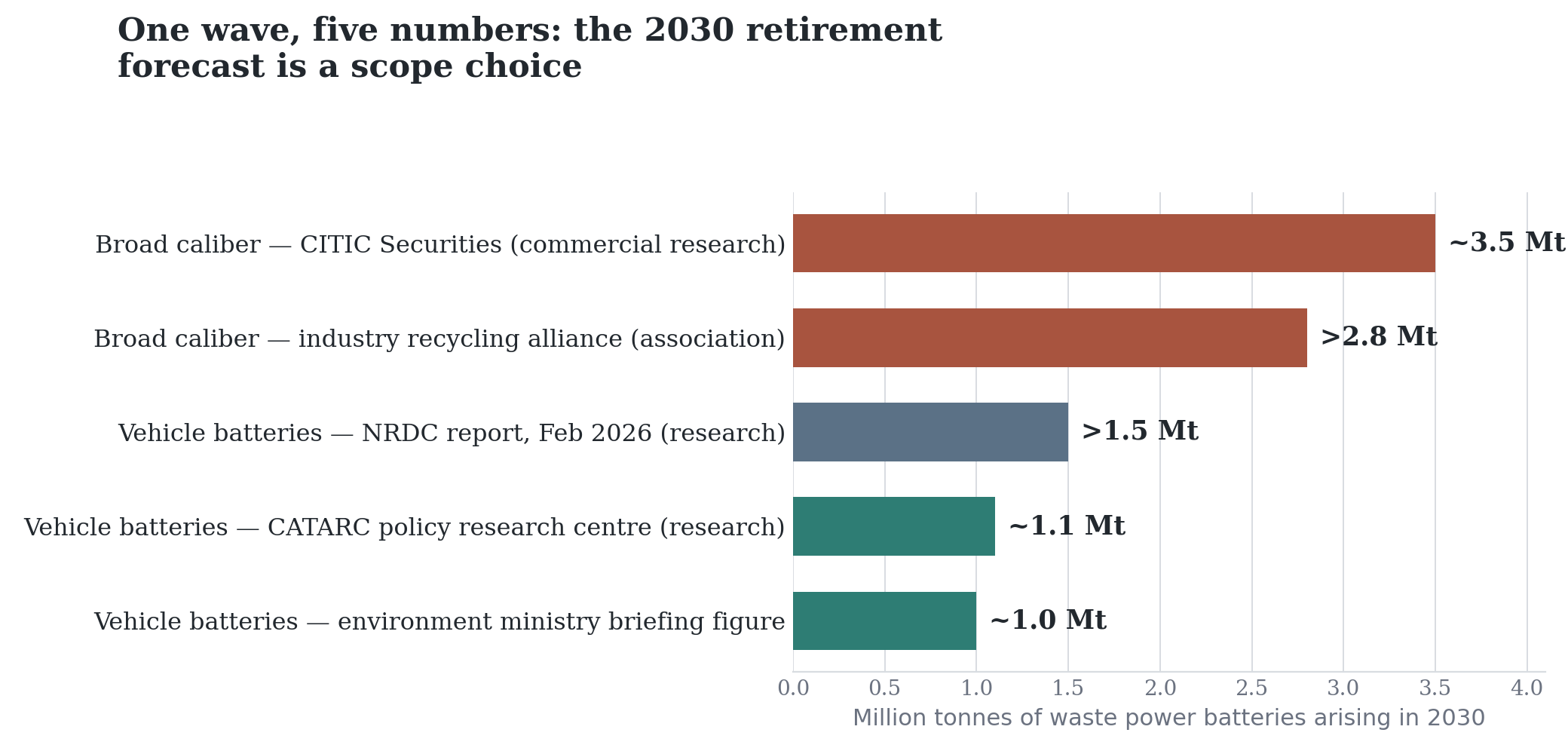
The first cluster counts the batteries that come out of vehicles. The second adds storage batteries, consumer batteries and factory production scrap — real tonnage that will compete for the same plants, but a different planning object. We present the calibers in parallel and do not split the difference: a reader sizing collection logistics should work from the vehicle-only cluster; a reader sizing plant capacity should work from the broad one.
The same discipline exposes a comparison that much coverage gets wrong. The environment ministry has put the 2030 figures for all three streams at roughly 1 million tonnes of batteries, 1.5–2 million tonnes of PV modules and 500,000 tonnes of blades — without, in any published version we could find, stating whether those are amounts arising in 2030 or accumulated by 2030. The magnitudes suggest the battery figure is an annual flow while the PV and blade figures behave like cumulative stocks; the ministry's wording settles neither.
What can be compared cleanly is the industry ministry's plan targets, which are explicitly annual utilization volumes for 2030: over 1 million tonnes of batteries, about 170,000 tonnes of blades — and about 80,000 tonnes of PV modules. The plan's own PV target is best read as a timing statement: on every caliber, the bulk of the PV retirement wave arrives after 2030, and an 80,000-tonne annual utilization target for 2030 implicitly dates the PV problem to the next decade — which is precisely the bet Document No. 206's encouragement-only language is making.
One more anchor from the formal channel's own books. In 2024, the formal system recycled just over 300,000 tonnes of power batteries into a market the industry ministry valued at over ¥48 billion — an implied average realized value of roughly ¥160,000 per tonne (WattAnalysis arithmetic: ¥48bn ÷ 300,000 t). That is a system value — collection, logistics, processing and materials together, across chemistries — and it is the prize the informal channel is competing for, tonne by tonne — the system-level value against which the per-kWh recovered-lithium value in the price-ceiling calculation below should be read.
The price ceiling: what a retired LFP battery is actually worth
Regulation decides where a battery should go. Arithmetic decides where it can go, and for the chemistry that dominates the coming wave — LFP, 69% of 2030 retirements on the NRDC split — the arithmetic is tight. This is where WattAnalysis's own price layer does work that the policy documents cannot.
Our cross-source composite for battery-grade lithium carbonate — series WA-PRC-28, built from SMM and Mysteel assessments, with Sunsirs added for the last two of five daily observations, 16–20 November 2026 — puts the current level at ¥89,600–91,700 per tonne — a level, not a trend; the series is five days old and we claim nothing from its direction. Our composite for a new LFP storage cell — series WA-PRC-29, for a 280Ah cell — is ¥0.354 per Wh, and our storage cost model — WA-PRC-20, run COST-ESS-20261121-R1, a modelled value for a 314Ah cell — puts a new cell's bill of materials at ¥0.345 per Wh.
Now the worked example, with every input on the table. LFP cathode is 4.4% lithium by mass (stoichiometry of LiFePO4), and a kilogram of lithium converts to 5.32 kg of lithium carbonate equivalent. At roughly 2.0 kg of cathode per kWh — our engineering assumption, stated so the arithmetic can be rerun; the result scales linearly with it — and 90% lithium recovery, the minimum China's 2024 norm conditions require of smelters (as republished by Hubei's provincial industry department) and used here as an assumption rather than a measured LFP yield, one kWh of retired LFP yields about 0.42 kg of saleable lithium carbonate.
At the WA-PRC-28 level (latest point ¥91,450 per tonne, 20 November), that is roughly ¥38 per kWh, or ¥0.038 per Wh: about 11% of the price of a new cell, before paying for collection, discharge, dismantling, processing, environmental compliance and margin. Halve the lithium price — it has moved by more than that within single years — and the recovered-lithium stream carries about 5% of a new cell's price.
The feedstock side agrees: Mysteel quoted scrap LFP batteries at ¥12,500–13,600 per tonne in mid-November 2026 — roughly one-seventh, tonne for tonne, of the price of lithium carbonate, of which an LFP battery contains only a fraction.
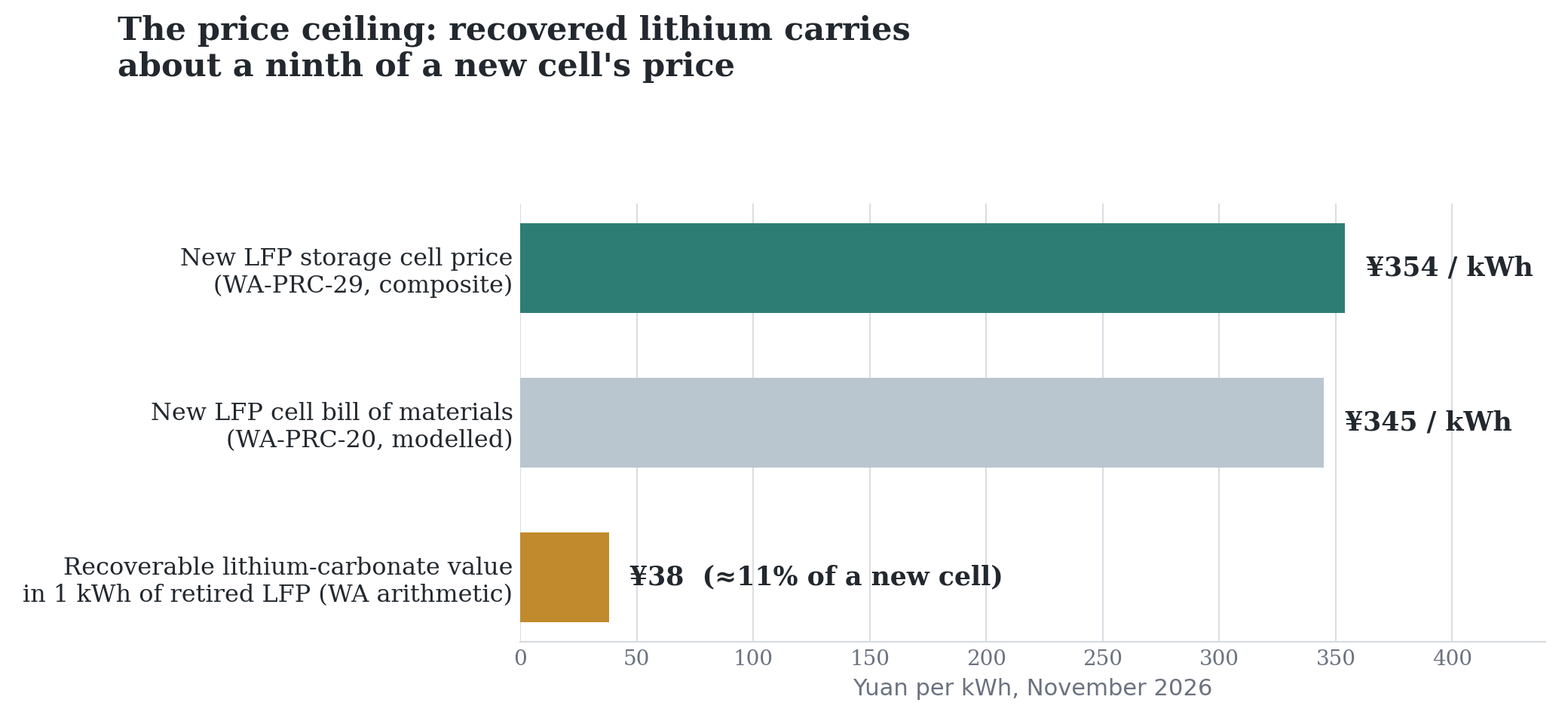
The conclusion the data points to is uncomfortable for the licensing model. For LFP, recycling is not a volume business with a regulatory moat; it is a long position in the lithium price, held against a new-cell price ceiling that our own series put at ¥0.354 per Wh at the latest of three weekly observations — a ceiling that is itself low and drifting down.
When lithium is expensive, formal recyclers can outbid workshops and still clear a margin. When it is cheap, the compliant cost stack — testing, reporting, environmental plant, invoiced inputs — is exactly what the informal channel does not carry, and no fine schedule in Order No. 73 changes that arithmetic. Ternary batteries, with cobalt and nickel aboard, sit higher in the value stack; we do not quantify them here because our price layer does not yet carry cobalt or nickel composites, and we would rather print the gap than borrow a vendor's number.
Where it fails: the routes around the stack
The price inversion is documented, not anecdotal. Press investigations that interviewed dismantlers directly found unlicensed workshops bidding up to about 30% more than listed firms for the same retired pack (Yicai, January 2026); a second investigation put the premium at 10–15% (Beijing Business Daily). Published estimates of the informal share of the retired stream span roughly three-fifths to three-quarters: at the high end, Yicai attributes a figure of about 75% both to the industry white paper and to the China Industrial Association of Power Sources, while a 2026 Nature Sustainability study puts the formally processed share at about 40% and an Engineering study at under 30% entering formal channels.
None of these is an official statistic, and we give the spread rather than a single headline figure. The mechanism is structural: a workshop with under ¥600,000 of setup, no environmental plant, no testing or warranty liability, and no need for the VAT invoice chain can simply pay more for feedstock. Document No. 206's passing reference to implementing "reverse invoicing" is the tell that formal firms' tax-document problem is real.
Against this, Order No. 73's fines are small, and they bite only after a correction order has been refused (up to ¥50,000 for network and ID failures; ¥10,000–30,000 for handing batteries to unauthorized parties). The stack's real teeth are not the fines but Article 42's list expulsion and the traceability platform's paper trail — instruments that work on firms inside the system. The workshop outside it is reached only by enforcement campaigns, which is why the April–June action matters and why its results, when published, are a metric to watch.
Separation before scrapping is the textual opening. The vehicle-and-battery rule binds at the scrapping transaction. A battery removed earlier — in a swap, a lease return, an accident write-off or a private sale — never reaches that transaction.
The Measures close the commercial part of this route expressly: swap operators are regulated source points that must hand dismantled batteries to utilization firms or producer networks, with monthly reporting. What remains open is the informal pre-scrapping market and one delegation gap: Article 21 deems a battery-missing vehicle incomplete but leaves the handling rules to a future measure — the same drafting pattern as the digital ID's operating detail. Both are "established in principle, specified later" provisions, and the specification dates are observable.
The PV and blade route-around is simply waiting. With generator responsibility at encouragement level and the management measure unwritten, deferral costs a generator nothing today. The counterweight in the documents is directed at state generators — Document No. 206 guides large central SOEs to lay out recycling networks and bases — which may build capacity ahead of obligation. Whether capacity built on guidance gets used without a mandate is the open question the 80,000-tonne plan target poses.
The European contrast: Brussels legislated a buyer
The comparison that isolates China's missing mechanism is not about stringency. On process standards China is in places stricter: its 2024 norm conditions require at least 90% lithium recovery in smelting, against the EU's material-recovery targets of 50% for lithium by end-2027 and 80% by end-2031 (Regulation (EU) 2023/1542, Annex XII) — though the two are not like-for-like: China's figure is a norm condition on licensed smelters, the EU's a statutory target.
What the EU has and China does not is a statutory buyer. From 18 August 2031, industrial batteries above 2 kWh (excluding those with exclusively external storage), EV and SLI batteries sold in the EU must contain at least 16% recycled cobalt, 6% recycled lithium, 6% recycled nickel and 85% recycled lead, where the battery contains the metal in its active materials; from 2036 the lithium share doubles to 12%, cobalt rises to 26% and nickel to 15% (Article 8).
A cell maker in Europe must purchase recovered material whatever the virgin price does — the demand side of the recycling market is legislated into existence, which is exactly the side that fails in China when lithium is cheap. China's nearest equivalent is an aspiration in the industry ministry's plan: that by 2030, lithium, cobalt and nickel recovered from waste batteries should supply 10–15% of what battery production needs.
It binds no buyer, names no battery, and attaches to no product. Until something like it does, the formal channel's economics remain a lithium-price derivative.
Q3. What it means, and what would prove us wrong
Those two numbers — the wave's size and the pack's carrying value — are what reprice the three positions below. For capital, the stack reprices three positions. Collection, not processing, is the scarce asset: network obligations make every battery and vehicle maker's sales map into a collection map, and the scrapping-rule revision hands the licensed vehicle-dismantling channel a structural feedstock advantage that listed processors — 148 firms before the July purge, running at roughly an eighth of certified capacity on the official pairing — will have to compete, or pay, for access to.
Processing capacity built ahead of feedstock remains the sector's asset most at risk of stranding: the white paper's 3.8 million tonnes of nominal capacity against the 623,000 tonnes its listed firms actually recycled is the balance-sheet version of the policy problem. And the echelon deletion transfers value from second-life integrators to materials regenerators and to whoever owns testing that can satisfy the single quality standard.
Our reading makes dated predictions, and we register them here. First, if the vehicle-and-battery rule is doing work, formal utilization growth should outpace retirement growth in official disclosures — industry-ministry officials have put 2025 utilization above 400,000 tonnes in conference remarks reported by 36kr this autumn (press-tier reporting of an official remark, not an official release); the 2026 figure, against 2026 retirements on the vehicle-only caliber, is the test.
Second, the two delegated instruments — the digital ID's operating rules and the battery-missing-vehicle handling rules — either appear in draft or final form during 2027 or the Measures' hardest provisions are running on principle alone; watch for both.
Third, the PV/blade management measure that Document No. 206 promises will either land with a generator obligation in it — contradicting our deferral reading — or arrive as another encouragement, confirming it; and if a recycled-content mandate appears in any Chinese instrument, the demand-side gap we identify against the EU closes and this analysis should be revised.
The comment and drafting calendars for all three tests are public. The stack is built; 2027 is when we find out whether it is load-bearing.
Sources and method: Order No. 73 of the six departments (full text, Ministry of Industry and Information Technology), promulgated 31 December 2025, in force 1 April 2026; MIIT Announcement No. 20 of 2026 (30 July 2026) and its removal-list attachment; the nine-department Opinions, Document No. 206 (Ministry of Commerce) — absence claims for Document No. 206 are made on the abridged official posting, the only version published as of 23 November 2026; MIIT's 15th Five-Year Plan for Green and Low-Carbon Industrial Development (2026) and the 2024 norm conditions (the 90% lithium-recovery figure as republished by Hubei's provincial industry department); the five-department joint enforcement notice of 27 April 2026; Ministry of Ecology and Environment briefing figures (November 2025) as reported by China Daily and restated by Xinhua — the ministry's 2030 figures carry no cumulative/annual qualifier in any published version, and we flag rather than resolve that ambiguity.
Retirement forecasts in the table are research, association and commercial-research estimates (CATARC; NRDC, February 2026; the industry recycling alliance; CITIC Securities), presented in parallel and not adjudicated. Hubei's draft waste-recycling regulation (provincial justice department posting, 2025) is the local contrast case.
Price and cost data: WattAnalysis series WA-PRC-28 and WA-PRC-29 (cross-source composites; medians with source counts as stated in the text) and model WA-PRC-20 (modelled); scrap-battery quotations from Mysteel. Stoichiometric inputs (4.4% lithium in LiFePO4; 5.32 kg of lithium carbonate equivalent per kg of lithium) are calculated from molecular weights and are WattAnalysis arithmetic, as are all ratios so marked.
Informal-channel shares and bid premiums are press and association estimates (Yicai, January 2026; Beijing Business Daily; Nature Sustainability; Engineering), labeled as such wherever used; no official statistic for the informal share exists. EU figures from the text of Regulation (EU) 2023/1542. All documents accessed 23 November 2026.