The River Becomes the Regulator
Beijing reorganises wind and solar around its hydro cascades — and the arithmetic shows both the logic and the limit

- Document No. 92 of 2026 makes hydro cascades the organising unit for new wind and solar: one entity, one bundled approval, one settlement curve across eleven named river basins.
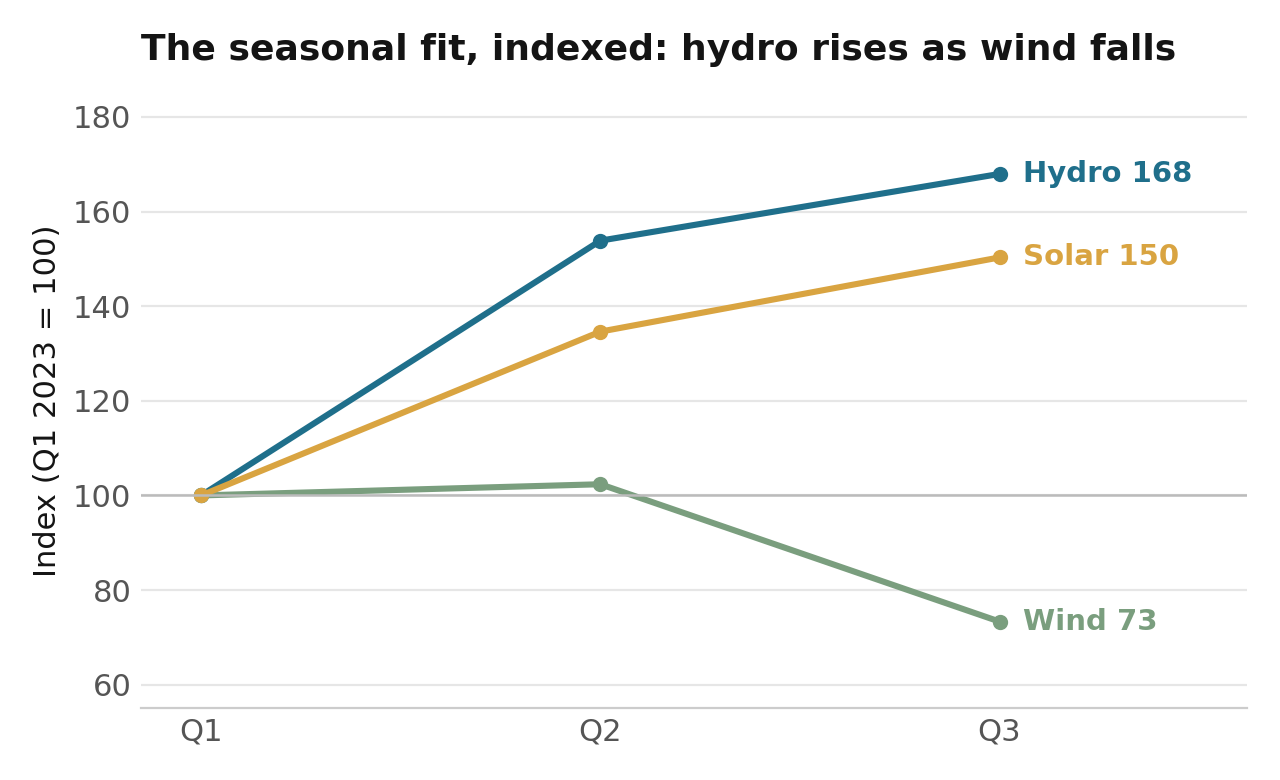
- The physics checks out seasonally: in 2023 hydro output rose 1.68-fold from Q1 to Q3 while wind fell to 0.73, on WattAnalysis arithmetic from NEA data.
- The framework's floor is 55 GW of attached renewables — eleven basins at the document's 5 GW minimum — but drought, dispatch priorities and capacity-credit gaming decide its real value.
China's newest renewables policy contains almost no numbers. The National Energy Administration's Guiding Opinions on Accelerating Basin-Level Hydro-Wind-Solar Integrated Development, Document No. 92 of 2026, signed on 9 November and posted on 18 November, sets no capacity target, no tariff and no deadline more specific than "positive progress" by 2030.
What it changes instead is organisational. From now on, along eleven named river basins, wind and solar are not to be planned, approved, dispatched or sold as standalone projects. They are to be planned, approved, dispatched and sold as appendages of the hydro cascade — by the hydro company, through the hydro station's grid connection, against the hydro reservoir's ability to absorb their variability.
That is a bigger change than another gigawatt target would have been. China's wind and solar fleet passed 1,990 GW this year. The binding constraint on the next increment is no longer how much can be built; it is who firms it, who dispatches it and who gets paid for the firming. Document No. 92 answers all three questions the same way: the river does.
This article reads the document clause by clause, tests its physical premise against the generation record in our own database, prices its minimum scale from the one number the document does contain, and then asks where the design breaks — because the last time a Chinese hydro province was stress-tested, in the Sichuan drought of 2022, the river failed at exactly the moment it was needed most.
One entity, one approval, one curve
The document's machinery sits in three clauses. Each removes a seam that, until now, separated a solar farm beside a dam from the dam itself.
Clause 2 defines the integrated project. It is developed and operated by a single entity. Hydro and new energy are bundled at one collection point, with — the text is specific — a clear physical interface, the same control level and the same main supply scope. A wind farm that merely sits in the same valley does not qualify. A wind farm whose output is pooled with the cascade's, under one operator's control hierarchy, does.
Clause 17 then rewires approval. Where new energy is bundled onto existing hydro, the new-energy part may be approved or filed as one single project, instead of as dozens of individual wind and solar filings. Where the hydro itself is incremental, the document goes further: developers may explore approving the hydro station and its attached new energy as one project. Anyone who has watched Chinese renewables development knows what this is worth. Approval sequencing — not equipment, not capital — is the critical path for most large projects, and the bundle collapses it into a single queue.
The same clause adds the money. Beijing will "in an orderly way" establish a reliable-capacity compensation mechanism, and eligible integrated projects will be brought inside its scope. The document names no price. But the direction matters: capacity payment is the mechanism by which firming gets paid for as a product in itself, rather than being cross-subsidised out of energy sales. The bundle is being offered two things money cannot usually buy in the Chinese system — a faster queue and a second revenue line — in exchange for surrendering its independence.
Clause 12 completes the design on the market side. Qualified integrated projects are to participate in electricity markets as a whole. Export-oriented bundles negotiate a single delivery curve and a single settlement mechanism with the receiving province, without distinguishing source type. In-province bundles are, progressively, to enter medium- and long-term, spot and ancillary-service markets as one seller.
Whole-bundle settlement has a quieter consequence worth naming. When an export bundle settles on one curve without distinguishing source type, the question of who inside the bundle absorbs curtailment — the solar block at noon, or the hydro unit that could have generated — becomes an internal transfer inside one company rather than a market outcome between companies. That is efficient when the operator's optimisation is honest. It also means the receiving province, and any outside analyst, sees a single smoothed product whose internal stresses are invisible. The bundle's opacity is not a bug introduced by careless drafting; it is the price of the integration, and it should be counted as one.
Read together, the three clauses describe a new market object. Not a power station, not a portfolio — a basin position: a block of variable generation stapled to a block of reservoir regulation, approved as one asset, dispatched as one unit, settled as one curve. The closest Western analogue is not a hybrid plant. It is a vertically integrated utility franchise, recreated inside a market that spent a decade unbundling exactly that.
The map: eleven basins, two jobs
The document names its geography precisely, and the naming is itself a sequencing decision.
Four basins are designated first movers: the Yalong River, the upper Jinsha, the upper Lancang, and southeast Tibet — the Yucha reach of the Yarlung system. Three more are in the planning-compilation tier: the middle and lower Yarlung Tsangpo, the Dadu River, and the middle and lower Jinsha. The northwest gets a supplementary tier built on different physics: the upper Yellow River in Qinghai, and two Xinjiang inland rivers, the Yarkand and the Kaidu, with pumped storage explicitly allowed to substitute as the main regulating source where conventional hydro is thin. The Hongshui River represents the rest — basins whose existing cascades have regulation to spare.
Eleven basin units in total. Governance follows the map. Under clause 18, provincial energy departments run integration inside their own borders. But basins involving major rivers, cross-province absorption over UHV DC lines, or new pumped storage built to serve specific sources are carved out: those work under NEA guidance. The centre keeps the rivers that cross borders. The provinces keep the rest.
The document also assigns each basin one of two jobs, and the choice of job is the choice of business model.
The first job is export. Basins rich in hydro and renewables but far from load are to be positioned for cross-province delivery. For basins already exporting, clause 6 prescribes the upgrade path: raise the conventional hydro fleet's regulating capability — including by adding or uprating units — so the existing corridor can carry more bundled wind and solar and run at higher utilisation. The corridor, in other words, is treated as a fixed asset whose throughput is to be raised by better firming, not by building a second line.
The second job is local conversion. Basins plugged into their own provincial grid keep their power, and where export is constrained the document encourages a third pattern: co-locating energy-hungry industry with the bundle — "hydro-wind-solar plus green-power conversion industries" — so the load moves to the electrons instead of the electrons moving to the load.
Sections six of the document then sketches what that load could be. Green hydrogen, ammonia and methanol. Green industry under multi-year green power purchase agreements. And, in clause 15, the most striking sentence in the text: a call to develop cavern-type computing facilities inside the idle underground caverns of built hydro stations — constant temperature, constant humidity, geologically stable — supplied directly by hydro-wind-solar power, with "flexible compute" loads that follow renewable output up and down.
We will return to the caverns. First, the physics — because the entire design rests on one empirical claim: that hydro and wind-solar output fit together well enough for a reservoir to do the firming. Our database can test the seasonal half of that claim.
The seasonal fit, measured
The generation database behind this site (dataset GEN, NEA full-caliber generation, press-conference series) carries quarterly cumulative output by source. Differencing the cumulative rows gives quarterly generation. The table below is 2023, the most recent year for which the quarterly series is complete in a single consistent calibre. The figures are observed NEA data; the quarterly increments and ratios are WattAnalysis arithmetic.
| 2023 | Q1 | Q2 | Q3 | Q3 ÷ Q1 |
|---|---|---|---|---|
| Hydro (TWh) | 203.5 | 313.1 | 341.8 | 1.68 |
| Wind (TWh) | 228.7 | 234.1 | 167.7 | 0.73 |
| Solar (TWh) | 113.5 | 152.8 | 170.6 | 1.50 |
| Wind + solar (TWh) | 342.2 | 386.9 | 338.3 | 0.99 |
| Hydro + wind + solar (TWh) | 545.7 | 700.0 | 680.1 | 1.25 |
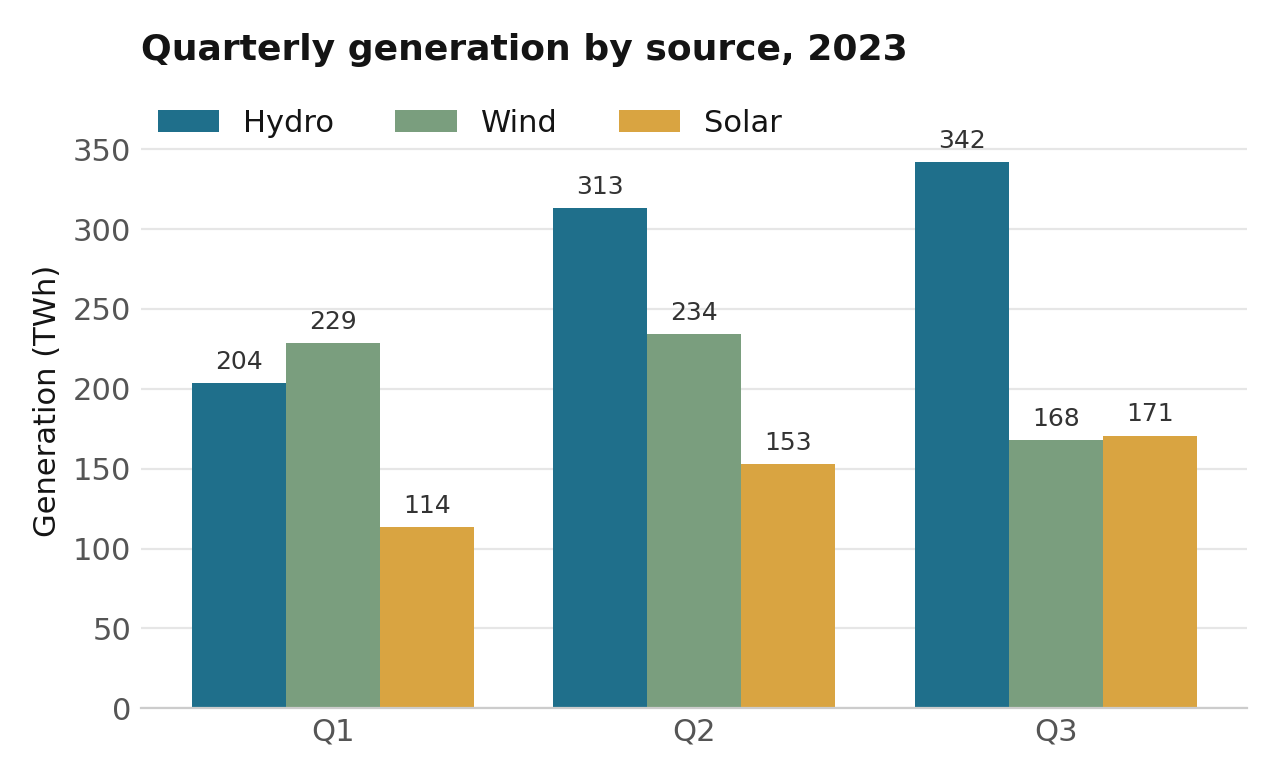
Three facts fall out of this table, and they are the document's real foundation.
First, hydro is the Chinese system's great seasonal swing. National hydro output rises by two-thirds between the dry first quarter and the flood-season third. No other source moves the system by 138 TWh between quarters. If any existing asset class can absorb new variability at scale, it is the one that already swings this much on a schedule.
Second, wind moves the other way. Wind generation peaks in the spring and falls to its weakest quarter in Q3 — 0.73 times its Q1 level — precisely when hydro crests. The anti-correlation is not perfect, but at national scale and quarterly resolution it is large and it is structural: monsoon-season wind lulls against flood-season rivers.
Third, solar does not spoil the fit. Solar also peaks in Q3, at 1.50 times Q1. But solar's swing is diurnal before it is seasonal — a midday block that a reservoir can shift into the evening by holding water back for a few hours, the cheapest firming there is. Combined wind and solar energy is almost flat across the three quarters (342, 387, 338 TWh). What changes is the composition — and composition, hour by hour, is exactly what cascade dispatch exists to manage.
Two honest caveats belong here. The full-year 2023 rows in the same dataset carry a different statistical calibre from the quarterly press-conference series, so we have not spliced them; the table stops at Q3 rather than pretend a precision the data does not have. And these are national aggregates. The document's claim is basin-level, and no basin-level generation series exists in our databases — a gap we flag rather than fill. The national numbers establish that the seasonal fit is real physics, not a slogan. They cannot establish that it holds on the Yarkand in August.
The one number in the document
For a text almost empty of figures, Document No. 92 contains one hard number, in clause 1. A single basin integrated base should, in principle, drive no less than 5 GW of new energy development.
Five gigawatts is a filter, not a target. It is roughly the scale at which a bundle justifies its own dispatch arrangements, its own settlement curve and its own approval track — and it is far above the scale of a decorative solar farm bolted onto a dam for reporting purposes. The clause is the document's anti-greenwashing device: below 5 GW of attached renewables, you do not have a basin base, whatever your press release says.
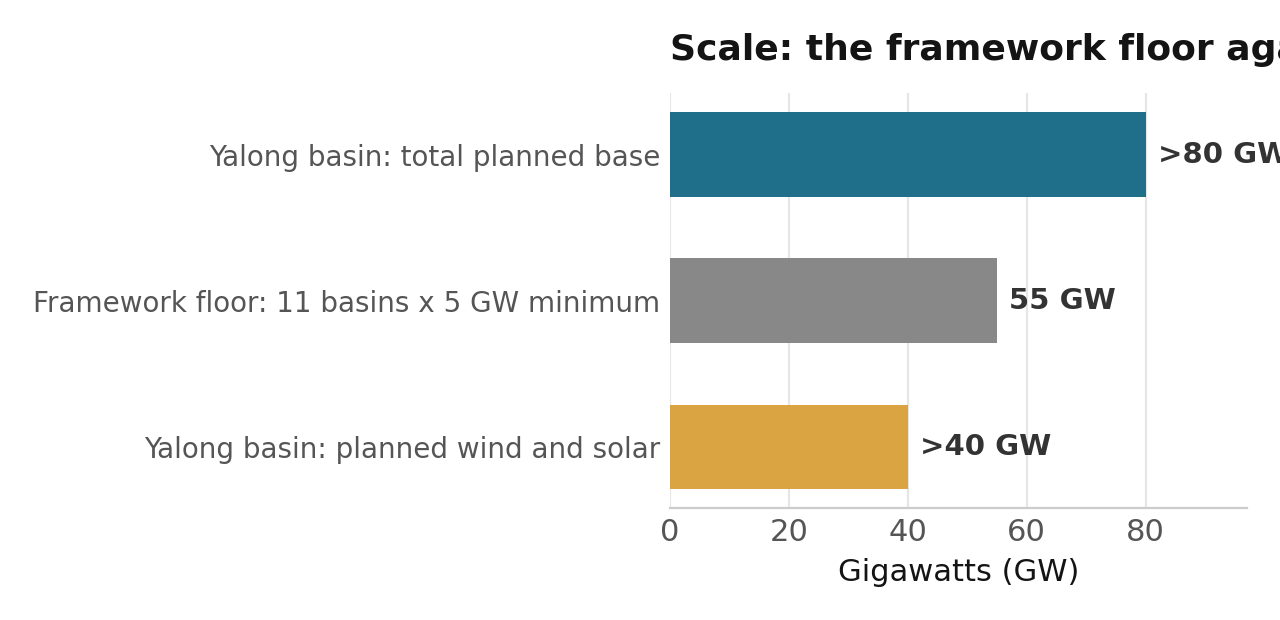
The number also lets us price the framework's minimum scale, which the document itself never does. The arithmetic is WattAnalysis's own. Eleven basin units are named. If each hosts at least one qualifying base at the clause 1 floor, the framework implies at least 55 GW of new energy attached to hydro cascades.
Set against the installed fleet — 692.7 GW of wind and 1,299.2 GW of solar as of August 2026, in the NEA full-caliber capacity series in our power-statistics database — that floor is about 2.8 percent of what already exists. The framework is not a marginal programme. Neither is it, at its floor, a transformation. Everything depends on how far above the floor the big basins go.
The Yalong shows how far that can be. The Yalong basin clean-energy base, written into the national plan in the previous cycle, is the template the document generalises. Its developer's published plan puts the basin above 80 GW in total: about 30 GW of hydro across 22 planned main-stem stations, more than 40 GW of wind and solar, and more than 10 GW of pumped storage, delivering above 220 TWh a year at full build-out. The regulating core is three large reservoirs — Lianghekou, Jinping-I and Ertan — with 14.8 billion cubic metres of combined regulating storage. The Kela solar plant, 1 GW commissioned in June 2023 and at the time the world's largest hydro-solar hybrid, is the base's proof of concept.
Two ratios from those plan figures deserve attention, both labelled as what they are — the developer's plan, not outturn data. The firming ratio: 30 GW of hydro plus more than 10 GW of pumped storage against more than 40 GW of wind and solar is roughly one-to-one — a gigawatt of regulating capacity for every gigawatt of variable capacity attached. And the concentration ratio: the Yalong's planned wind and solar alone, above 40 GW, equal about three-quarters of the entire eleven-basin minimum derived above. The framework's centre of gravity is not eleven basins. It is two or three very large ones, with the rest as a tail.
Contrast the northwest tier, where the same document describes a materially weaker machine. The upper Yellow River has real cascades and a real developer, but its regulating reservoirs are smaller relative to the wind and solar resource around them, and the two Xinjiang inland rivers — the Yarkand and the Kaidu — are desert rivers: seasonal, ecologically fragile, and already spoken for by irrigation in an arid region. Clause 4's permission to substitute pumped storage as the main regulating source is the document conceding the point. A pumped-storage-led bundle is a different asset from a cascade-led one: the regulation must be built and paid for, rather than inherited from a dam that already exists, and its economics run through the capacity-compensation mechanism of clause 17 rather than through a reservoir's sunk cost. If the southwest tests whether integration works when the firming is nearly free, the northwest tests whether it works when the firming must be bought. Both answers matter; they will not arrive at the same time.
The capital-allocation consequence follows directly. The document hands the basin franchises, in effect, to the incumbent cascade developers — the Yalong's developer on the Yalong, the Lancang cascade's developer on the Lancang — because clause 2's single-entity rule makes the hydro owner the bundle's natural and usually only plausible operator. For those companies, attached wind and solar at a 5 GW minimum per base is the largest growth mandate available in Chinese power: the Yalong plan alone carries more than 40 GW of new energy, against a national market where independent developers compete for provincial quotas project by project. For everyone else, the document closes a frontier. Basin-adjacent renewables that might have been developed independently will increasingly be developed inside someone else's bundle, on the bundle's timetable, or not at all.
That concentration is why the first-mover list matters more than the full map. The Yalong already has its cascade, its reservoirs, its developer and its export corridor. The upper Jinsha and upper Lancang have cascades under construction and single dominant developers. The Yarlung Tsangpo, by contrast, sits in the planning tier for a reason: its lower-reaches project is the largest and most politically complex hydro undertaking in the country, and a basin base built on it is a 2030s story whatever the document's 2030 language says.
What our project data cannot see
A WattAnalysis deep dive is supposed to bring our own data to the question, so here is the uncomfortable part, stated plainly.
Our project database — 858 tracked projects with milestone records — contains no basin hydro, wind or solar projects at all. Every record in it is an energy-storage project; the database was built storage-first. The named-basin pipeline of Document No. 92 is, today, invisible in our project layer. We cannot tell you which Yalong wind farms have been filed, which upper-Lancang solar blocks are under construction, or how the bundle's milestones are distributed — because the layer that would know does not cover this asset class.
This is not a footnote. It is the live application of our Pipeline Conversion model (model M9), whose core finding is that milestone data of the kind we hold is a single-node cross-section: it shows where projects are, never how fast they convert, and a conversion rate from announcement to operation cannot be measured from it. M9's discipline is an observability audit — before quoting any pipeline number, state which layer can actually see which stage.
Applied here, the audit returns a clear verdict. Announced basin scale — the 80 GW Yalong plan, the 5 GW floors, the eleven named rivers — is planning-stage information. It becomes investment-stage information only when approvals, filings and construction starts surface in a layer that records them. Our monthly longitudinal re-capture of project status, which begins this month for the storage pipeline, is the mechanism we would extend to the basins; until then, the honest status of the No. 92 pipeline in our data is: named, floored, and unobserved.
Readers should hold every party's basin numbers — including, especially, the round ones in planning documents — to that standard.
Where the design stalls
The document is well built. It is still a design for a system that has failed this exact test before, in four specific places.
The reservoir does not belong to the power system. Clause 11 calls for joint optimised dispatch of the cascade — and then lists the objectives dispatch must balance: flood control, ecology, water supply, irrigation, generation, navigation and safety. Generation is fifth of seven. In a wet year the constraint is flood limits on reservoir levels; in a dry year it is downstream ecology and irrigation. The reservoir's first obligation is the river. Every firming promise the bundle makes to the grid is junior to a flood-control rule curve that no electricity market can amend. This is not a flaw in drafting; it is the physical constitution of a Chinese cascade, and it caps how much regulation the bundle can contractually sell.
Drought breaks the hedge at the worst moment. The complementarity table above is an average year. The failure case is a correlated one: heat raises demand while drought cuts the river. Sichuan lived it in 2022. Contemporary provincial reporting put July inflows on the Dadu and Min rivers more than 40 percent below the multi-year average, and early-August inflows more than 60 percent below, while a record heatwave pushed provincial load roughly a quarter above the previous year's peak. Stations with seasonal-or-better regulation made up under 40 percent of the province's hydro capacity; the rest was run-of-river that fell with the flow. Effective hydro capacity roughly halved at the trough, and industrial users were rationed.
Wind and solar attached to those cascades would not have saved the week — solar helped at noon, but the firming asset itself was what failed. A basin bundle concentrates this risk by construction: the more of a province's supply is stapled to one river, the more a dry river becomes a provincial event rather than a portfolio event.
Provinces still hold walls the document does not breach. Clause 18's carve-out is the tell. Beijing kept the cross-border rivers for itself precisely because the default — provincial control — has historically meant provincial dispatch preference, provincial settlement and provincial reluctance to firm a neighbour's renewables. For the in-province tier, the document exhorts; it does not override. Clause 12's unified delivery curve works for export bundles because a receiving province signs it. Inside one province, "participate as a whole" still runs through a provincial dispatch centre whose incentives the document leaves untouched.
The bundle can be gamed, and the capacity payment invites it. Clause 17's single-approval track and clause 12's whole-bundle settlement are worth a great deal, and anything worth a great deal will be optimised against. Expect — this is WattAnalysis judgement, not document text — developers to attach the maximum attachable renewables to the minimum viable hydro anchor: a mature cascade with modest remaining regulation headroom can, on paper, sponsor a very large bundle. The capacity-compensation mechanism sharpens the question. If a bundle is paid for reliable capacity, who measures the reliability — at what hour, in what water year, net of the flood-control rule curve? A compensation regime that credits nameplate-adjacent capacity will be gamed the way every credited-capacity regime is gamed: by maximising credited, not deliverable, firmness. The document establishes the mechanism and leaves the measurement to later rules. Those later rules are where this policy will actually be decided.
Two smaller cautions complete the list. The corridor is a real gate: clause 9 sensibly requires new export channels to be sized with the bundle, but transmission in China is built by grid companies on their own planning cycle, and a base whose channel slips five years is a curtailment story, not an integration story. And the cavern compute clause, for all its charm, describes a load that does not yet exist at scale: flexible, interruptible computing that follows a river's output is a research programme wearing a policy costume. Treat it as option value. Do not underwrite it.
What would prove it
Document No. 92 will be judged, like every Chinese energy framework document, not by its text but by the instruments that follow it. Three observations, all checkable, will separate a market change from a planning circular.
First, approvals. If clause 17 is real, the first bundled approvals — new energy filed as a single project on an existing cascade — should appear in the first-mover basins during 2027. None by the end of 2027, and the clause is decorative.
Second, settlement. If clause 12 is real, at least one export bundle will publish or be reported operating under a unified delivery curve that does not distinguish source type. That is the moment the basin position becomes a traded object.
Third, the capacity rules. The reliable-capacity compensation mechanism's measurement standard — the water year, the hour, the derating — will tell us whether Beijing is buying firmness or buying labels. A standard written against deliverable output in a dry year is a market. A standard written against installed ratios is a subsidy.
Our own commitment is narrower. The basin pipeline is unobserved in our data today; we intend the monthly project-status re-capture to close that gap for the first-mover basins, and we will report the pipeline as it becomes visible — approvals and filings first, press-release gigawatts last.
The river, meanwhile, is already the regulator of the Chinese system in the only sense the data fully supports: it swings more energy between seasons than any other asset, against the wind's own swing. Document No. 92 is Beijing's attempt to turn that physical fact into an institutional one — one entity, one approval, one curve, eleven rivers. The physics checks out. The institutions are the bet.
Sources and method: NEA, Guiding Opinions on Accelerating Basin-Level Hydro-Wind-Solar Integrated Development (Document No. 92 of 2026), full text, nea.gov.cn, posted 18 November 2026 — clause numbers as cited. Generation data: WattAnalysis dataset GEN (NEA full-caliber generation, press-conference calibre), quarterly cumulative rows differenced by WattAnalysis; full-year 2023 rows in the same dataset are a different calibre and were not spliced. Capacity data: WattAnalysis power-statistics database (NEA full-caliber, August 2026). Yalong basin figures: the basin developer's published plan as carried by state media — plan figures, not outturn data. Sichuan 2022: contemporary provincial reporting, labelled as such in the text. Project-pipeline assessment: WattAnalysis project database (858 records) and Pipeline Conversion model M9 observability audit. No figure in this article comes from a source we could not inspect.