The Cliff With No Tariff on It
On 28 November, China’s suspended refusal presumption on US-bound gallium, germanium, antimony and superhard materials revives — a cliff that moves no tariff. WattAnalysis runs the arithmetic.

- Announcement No. 72’s suspension expires 27 November: absent an extension, licences for US-bound gallium, germanium, antimony and superhard materials return to refusal in principle.
- Our landed-cost model holds the US storage duty stack at 25 percent across all three scenarios: the November and January cliffs move no tariff, landed-cost change zero.
- The January gate is materials licensing: the US took $7.36 billion, 9.3 percent, of China’s battery exports in 2026’s first nine months (WattAnalysis customs data).
On 28 November 2026, a sentence comes back to life. It is the second paragraph of China's Announcement No. 46 of 2024, suspended for a year by Announcement No. 72 of 2025, whose suspension runs out on 27 November.
If no extension is published in the next three days — none had been as of 24 November, when we checked the ministry's announcement lists again — licences for gallium, germanium, antimony and superhard materials bound for the United States go back to being refused in principle, and graphite bound for the United States goes back under stricter end-user and end-use review.
Nothing else changes. No tariff rate moves, in either direction, on either side of the Pacific. That is the point of this piece, and it is the point most coverage of this date will miss.
The 28 November cliff is an export-control event wearing a trade-war costume. Run it through a landed-cost model — we did, with our own — and the price effect is exactly zero, in every scenario, including the worse one that follows in January.
The exposure sits somewhere a spreadsheet of duties cannot see it: in a licensing presumption in Beijing, in the end-use file of a graphite shipment, and, from 11 January, in the anode and cathode materials inside a battery trade that was worth $7.4 billion to the United States in the first nine months of this year alone.
This article works through the instrument itself, the arithmetic, and the trade underneath it. It also marks, plainly, the places where our own data runs out.
One paragraph of one announcement
Announcement No. 46 was issued by the Ministry of Commerce on 3 December 2024, effective on publication. It is short enough that its structure is the story.
Its first paragraph bans exports of dual-use items to United States military users, or for United States military end uses. That paragraph has never been suspended. It is in force today and it stays in force whatever happens this week.
Its second paragraph is the one with the clock on it. In the ministry's words, licences for dual-use items related to gallium, germanium, antimony and superhard materials bound for the United States will in principle not be granted; for graphite, end-user and end-use review for US-bound shipments will be stricter.
Then comes an unnumbered closing clause, easy to skim past. Any organisation or individual, of any country or region, that transfers or provides China-origin covered items to a United States organisation or individual in violation of the announcement will be held legally liable. That clause is not part of paragraph two. Announcement No. 72 did not suspend it. It has been live throughout.
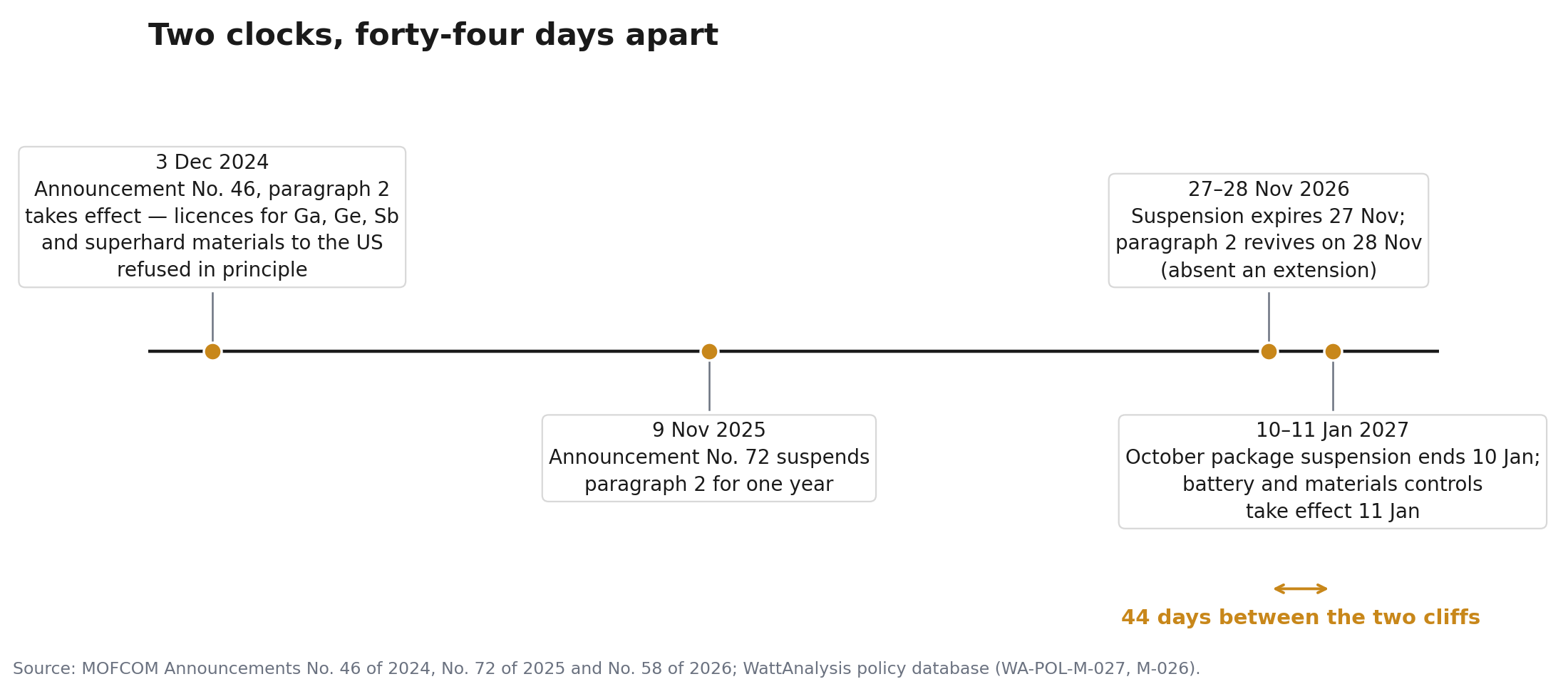
Announcement No. 72 of 2025, issued on 9 November 2025 as part of the package that followed the Kuala Lumpur consultations, is a single sentence. From the date of issue until 27 November 2026, paragraph two of Announcement No. 46 is suspended.
One more piece of chronology matters for calibration. Paragraph two is not a new weapon being unsheathed. It was live law for eleven months, from 3 December 2024 until the suspension, and the supply chains it governs have already operated under it once. Revival is a return to a known regime, with known paperwork and known counterparties — which cuts both ways. Buyers know what the queue feels like. So does the ministry issuing the licences.
Suspension is not repeal. The text of No. 46 was never amended, and the items in paragraph two never left China's dual-use control list. Gallium and germanium have required an export licence for every destination since August 2023. Graphite has required one since December 2023. Antimony and superhard materials since September 2024.
What the suspension switched off, therefore, was not licensing. It was the presumption attached to one destination. For a year, a US-bound application for these items has been read the way an application for any other destination is read: case by case, on its end-user and end-use file.
On 28 November, absent an extension, the presumption switches back on. "In principle not granted" is the operative phrase, and both halves of it matter. It is a presumption of refusal, not a statutory ban — the ministry keeps the discretion the words reserve. But a presumption is what a licensing officer applies to the file in front of them, and it is what an exporter's compliance department prices.
Graphite's position in the paragraph deserves a second look, because it is the only one of the five named materials with a mass-market industrial chain attached. Gallium, germanium, antimony and superhard materials get the refusal presumption. Graphite gets something softer in wording and, in practice, harder to route around: stricter review of who is buying and what for. A refusal presumption can be waited out or lobbied against. A review standard lives inside every single transaction.
Two clocks, forty-four days apart
The 28 November date is not the only one in this stack, and treating it as the whole story understates what is scheduled.
In October 2025, Beijing issued a much larger package: five more rare earth elements, an extraterritorial rule reaching foreign-made products containing as little as 0.1 percent Chinese rare-earth value, rare-earth technology controls, and — the item that matters here — controls on lithium batteries and synthetic graphite anode materials.
That package was suspended before it took effect, first by Announcement No. 70 of 2025 and then, on 9 November 2026, continued by Announcement No. 58 of 2026. Its current suspension runs to 10 January 2027. If it is not extended again, it takes effect on 11 January 2027.
So the calendar holds two cliffs, forty-four days apart. The first revives a US-specific presumption over five strategic materials. The second switches on a global licensing package whose battery chapter covers high-energy-density cells and, more consequentially, the cathode and anode materials that go into ordinary ones.
The asymmetry between the two clocks is the most informative document in the file. When Beijing extended the October package on 9 November, it wrote a new date for that package and left Announcement No. 72 untouched. The extension instrument was already open on the desk. Adding one sentence for paragraph two of No. 46 would have cost nothing.
It was not added. One reading — ours, and we label it as judgement, not fact — is that the 46 paragraph is older than the Kuala Lumpur arrangement, dating from December 2024, and Beijing does not regard it as part of what was traded there. Another is that a revival that costs China nothing in tariff terms is a cheap signal to send on schedule.
Either way, the observable is the same. As of 24 November, the 27 November date stands in every official source we can check, and the burden of movement is on an extension that has not appeared.
The arithmetic of a cliff that charges nothing
To make the "not a tariff" claim falsifiable rather than rhetorical, we ran it through our landed-cost model — the Landed-Cost Pass-Through model, version 1, run on 24 November 2026 — which builds the delivered price of Chinese energy hardware from our cost and price databases and the duty measures registered in our policy database. All outputs in this section are model outputs, not observed prices.
The model defines three scenarios. S0 is the status quo on the assessment date: paragraph two suspended, the October package suspended, graphite's standing licence requirement in force. S1 is the revival: paragraph two back in force from 28 November. S2 is both cliffs: S1 plus the October package taking effect on 11 January 2027.
Here is the duty stack the model applies, identical in all three scenarios. United States: a 25 percent additional duty on non-electric-vehicle lithium-ion batteries, in force since 1 January 2026, and 50 percent on solar cells. European Union: a 2.7 percent most-favoured-nation duty on lithium-ion accumulators and zero on solar cells. No measure in our register changes any of these rates on 28 November or on 11 January, because the instruments that move on those dates are Chinese export controls, not destination tariffs.
The model's landed costs under S0 make the point concretely. A two-hour storage system lands in the United States at $0.0986 per watt-hour and in the European Union at $0.0810. A 280-amp-hour storage cell lands at $0.0652 and $0.0536 respectively. A photovoltaic module lands at $0.1649 per watt in the US and $0.1099 in the EU.
Under S1, every one of those numbers is the same. Under S2, every one of those numbers is the same. The scenario difference in the landed-cost matrix is zero — not approximately zero, and not zero because we failed to model something. Zero is the computed result, and it is the finding.
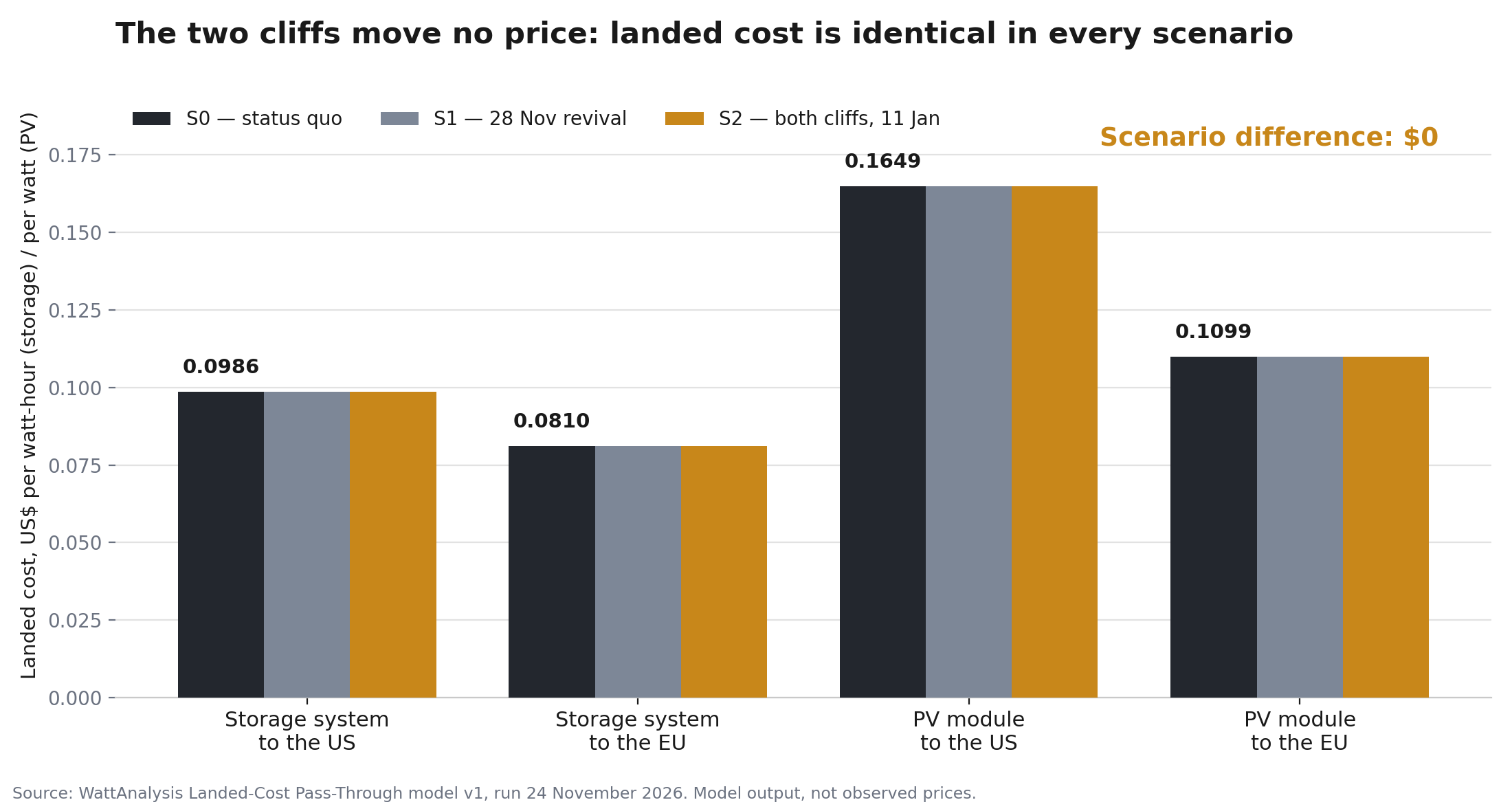
A worked example, from the model's published inputs, so the arithmetic can be checked. Take a 100-megawatt-hour two-hour storage system. Our cost database puts two-hour system equipment cost at ¥0.535 per watt-hour. One hundred million watt-hours at that cost is ¥53.5 million; converted at ¥6.7827 to the dollar, the PBoC central-parity average for the third quarter of 2026, that is a $7.89 million FOB proxy. Apply the US stack of 25 percent and the landed figure is $9.86 million. Apply the EU stack of 2.7 percent and it is $8.10 million.
Now flip the calendar to 28 November, and then to 11 January. The US figure is still $9.86 million. The tariff column does not know that anything happened.
The same exercise on the solar side, for readers whose exposure sits there. One gigawatt of modules at the integrated full cost in our cost database, ¥0.7454 per watt, converts to a $0.1099-per-watt FOB proxy. Landed in the EU at a zero MFN rate, a gigawatt is $109.9 million. Landed in the US under the 50 percent additional duty, it is $164.9 million. On 28 November and again on 11 January, both figures are unchanged to the cent. The entire $55 million transatlantic difference is a tariff artefact that already exists; the cliffs add nothing to it.
For contrast, the model does carry a sensitivity for the thing that is not scheduled: a hypothetical further 10-percentage-point US additional duty. At full pass-through, that would raise the US landed price of storage by 8.0 percent — the $9.86 million system becomes $10.65 million. We keep that number in a separate box labelled sensitivity, because no such measure is in force or announced. Confusing it with the November and January events is exactly the error this article exists to prevent.
Two margin figures from the same model frame who could absorb a real tariff if one ever came. Photovoltaic modules are already priced below their integrated full cost in our cost database — a margin of minus 3.5 percent — so an exporter's room to absorb any new duty is nil. Storage systems carry roughly 7.8 percent of headroom on the comparison caliber we use. Neither figure changes on 28 November either. They are context for a different risk than the one arriving this week.
What trade sits under each clock
If the price effect is zero, the natural next question is what the licence gate actually stands in front of. The two clocks stand in front of very different trades.
Under the November clock, the honest answer begins with a gap in our own house. Our trade database's destination-level layer covers batteries, electric vehicles and solar products. It does not carry destination series for gallium, germanium, antimony, superhard materials or graphite. We cannot size the US-bound trade in the five named materials from our own data, and we will not borrow a number we cannot stand behind to fill that space.
What can be said from the texts is where the transmission channel runs. Of the five, graphite is the material wired into the energy-hardware chain at scale, as the anode of nearly every lithium-ion cell China exports. Paragraph two does not refuse graphite licences in principle. It raises the review standard on every US-bound shipment, which in practice means longer files, more end-use evidence, and a standing possibility of refusal that a buyer must plan around.
Our cost data can bound that channel from above. In the two-hour storage system's equipment cost of ¥0.535 per watt-hour, the cell accounts for ¥0.345 — 64.5 percent. Everything graphite-related sits inside that cell layer. Our bill-of-materials data, at its current version, does not split the cell into its materials, so the anode's own share cannot be folded out of the 64.5 percent. We name that as a data gap rather than estimate it, because the difference between a bounded exposure and an invented one is the whole product.
Under the January clock, the trade is measurable, and it is large. The battery item in the October package covers rechargeable cells and packs at or above 300 watt-hours per kilogram — a threshold mainstream lithium-iron-phosphate storage cells sit below. Read narrowly, that sounds like a small door. Read with its materials items, it is not: the same announcement lists cathode materials including high-compaction LFP, and artificial and blended graphite anode materials, with no energy-density escape hatch. The January constraint on the battery trade is a materials licence, not a licence on the finished battery.
Graphite, meanwhile, is the one material standing under both clocks, under two different legal treatments. From 28 November, US-bound graphite faces stricter end-use review under paragraph two — a destination-specific measure. From 11 January, if the October package takes effect, artificial and blended graphite anode materials face licensing for every destination — a product-specific measure. A US buyer of Chinese anode material crosses the first gate in November and the second in January, and the two gates ask different questions: the first asks who you are, the second asks what the material is.
So the right exposure number is not the value of batteries above a threshold. It is the value of the battery trade whose inputs become licensable. From our customs database, series WA-BAT-01, covering HS 85076000 in the customs platform's destination caliber: the United States took $7.36 billion of China's lithium-battery exports in the first nine months of 2026, 9.3 percent of the $78.77 billion world total. Germany, at $11.08 billion, is now the larger destination.
A year earlier the picture was different. In the first nine months of 2025 the US share was 16.1 percent, $8.91 billion of $55.39 billion; across 2025 as a whole it was 15.5 percent. The share has nearly halved in a year, a shift consistent with the 25 percent US additional duty that took effect on 1 January 2026 — we say consistent with, because destination shares have more than one parent.
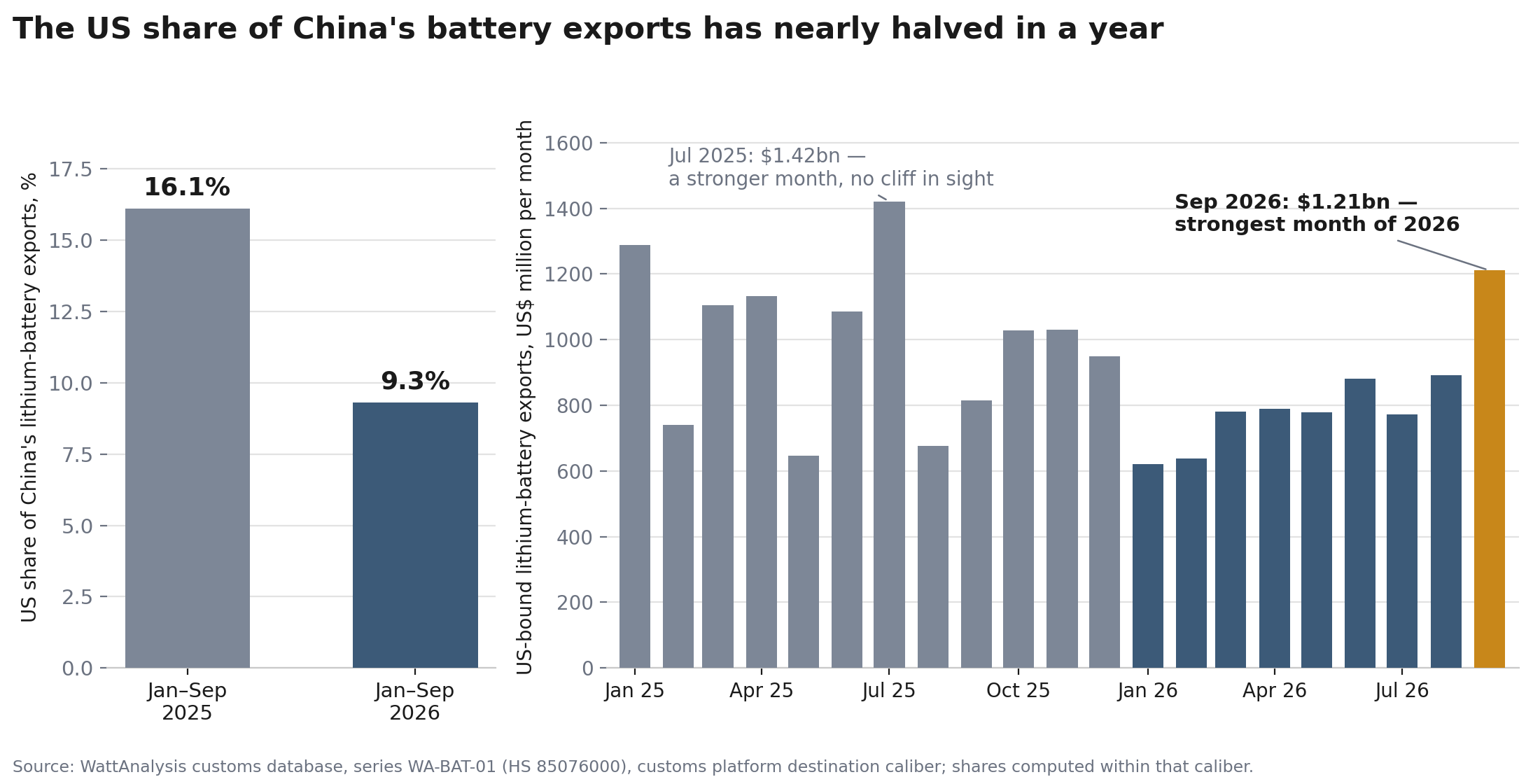
Two conclusions follow. First, the January materials gate stands in front of a US battery flow running at roughly $0.82 billion a month, about $9.8 billion annualised on our arithmetic. Second, that flow has already been shrinking under a tariff. The export-control layer arriving in January does not tax what is left. It decides, shipment by shipment and material by material, whether the inputs for it leave China at all.
Where the gate leaks, and where it holds
A licensing presumption is not a wall, and the texts themselves mark the seams.
The most obvious route around a US-specific measure is a third country: ship to an intermediary, sell on to the United States. Paragraph two's closing clause is written directly at this. It attaches legal liability to any person, anywhere, who transfers China-origin covered items onward to the United States in violation of the announcement. As a matter of text, that is a long arm.
As a matter of enforcement, the arm is only as long as its evidence. Liability requires proving Chinese origin and a violating transfer, typically after the fact, against a party who may sit outside Chinese jurisdiction. Our judgement: the clause deters documented, invoice-visible transshipment by parties with China exposure to lose. It does not, by itself, close a route run through parties with nothing in China to seize. That distinction — between a clear textual prohibition and a route that works until a regulator names the actor — is the honest way to read it.
Transformation is the softer seam. Graphite shipped to a third country and processed there into anode material is no longer, in any simple sense, the listed item that left China. Whether Chinese-origin content follows the material through processing is a question the November instrument does not answer; the October package's 0.1 percent rule answers it for rare earths, not for graphite. Anyone building a compliance position on offshore anode processing is building on that silence, and should know it is silence.
End-use review has its own games. Stricter review of graphite's end user invites paper end users — a civilian intermediary whose file is clean and whose customer is not examined. The counterweight is that review is discretionary and cumulative: a licensing authority that suspects a pattern does not need to prove it to slow the next file down. Under a presumption regime, friction is not a bug in the instrument. Friction is the instrument.
Timing games are already visible in the data, though we are careful about how much they prove. US-bound battery exports in September 2026 were $1.21 billion, the strongest month of this year and 49 percent above September 2025. Pull-forward ahead of a control calendar is the obvious story, and September sits conveniently between the two cliff dates' announcement and arrival. But the same series produced a $1.42 billion month in July 2025 with no cliff in sight. One strong month is consistent with stockpiling. It is not evidence of it, and we do not present it as such.
There is also a silence in the texts that exporters will feel before any of the above. Neither announcement says what happens to licences applied for, or granted, during the suspension year once the presumption returns. A file lodged on 20 November under case-by-case review may be decided on 5 December under a presumption of refusal; a licence granted in October may or may not carry its shipments past 28 November. The instruments do not grandfather, and they do not revoke. They simply do not say — and in a licensing system, an unanswered transition question is itself a reason to ship early or not at all.
Finally, the presumption cuts both ways, and a complete account has to say so. "In principle" reserves discretion to grant. Licences for these materials to other destinations have continued throughout the control era, and nothing in the revived text prevents the ministry from approving a US application it finds clean. What revival changes is the default, the burden of proof, and the queue — not the legal possibility. Buyers who treat 28 November as a hard embargo will overpay for insurance. Buyers who treat it as nothing will discover what a presumption feels like at the level of a single delayed shipment.
What the texts do not provide is any window into the gate's operation. The ministry publishes no approval or denial counts for these items and no processing-time commitment. Whether the revived presumption binds hard or softly is therefore an empirical question, and the first place it will show up is in customs data: US-bound gallium, germanium, antimony and graphite flows for December 2026, published in January 2027. Our own database does not yet carry those series. Closing that gap is on us, and we note it here so the follow-up can be checked.
What would settle it
Three of the claims in this piece are registered in our forecast registry, sealed on 24 November 2026, so that they can be graded rather than remembered kindly.
First, the revival itself. Our registered prediction is binary: no extension is published before midnight, China time, on 27 November, and paragraph two of Announcement No. 46 stands revived on 28 November. A single extension announcement in the next three days falsifies it, cleanly and completely. This is the rare forecast that resolves within the week.
Second, the tariff stack. We predict the US additional duty on the registered storage and battery measures remains at 25 percentage points through 30 June 2027, with no new line taking effect — the formal version of this article's claim that the November and January events are not tariff events. A United States measure that adds to the stack falsifies it.
Third, the European side of the matrix: the EU's total duty on Chinese lithium-ion accumulators remains its 2.7 percent MFN rate through 2027, with no anti-dumping or countervailing duty in force. Brussels has surprised this sector before; the prediction is registered anyway.
Around those three, the dated observables are simple. Watch the ministry's announcement list between now and 27 November for the extension that would end the story. Watch for Announcement No. 58 of 2026's own clock as 10 January approaches. And watch December's destination trade data in January for the first fingerprint of the presumption at work — US-bound volumes of the four refused-in-principle materials against graphite's reviewed flow.
The lesson of the 28 November date is one this publication expects to repeat. In the current phase of the US–China contest over energy hardware, the binding instruments are increasingly administrative: presumptions, review standards, list entries and expiry dates, set in one-sentence announcements that move no price on the day they land. The money is not in the tariff column. It is in knowing which gate your supply chain walks through, and when the presumption on the other side of it changes.
Sources and method
Primary texts: MOFCOM Announcement No. 46 of 2024 (issued 3 December 2024) and Announcement No. 72 of 2025 (issued 9 November 2025), read in the original on the ministry's export-control portal; Announcement No. 70 of 2025 and Announcement No. 58 of 2026 for the October package's suspension chain; Announcements No. 23 and No. 39 of 2023 and No. 33 of 2024 for the standing licence layer. The extension check was re-run against the ministry's announcement lists on 24 November 2026.
Policy measures are cited from the WattAnalysis policy database by measure ID (WA-POL-M-027 for paragraph two; WA-POL-M-024 for graphite licensing; WA-POL-M-026 and WA-POL-M-036 for the October package; WA-POL-M-005, M-002, M-011 and M-012 for the duty stack), status as recorded in the database's status history (WA-POL-H-002 to H-004).
Trade figures are from the WattAnalysis customs database, series WA-BAT-01 (HS 85076000), destination caliber from the customs statistics platform; world totals cross-checked against the published-table caliber, with which they reconcile. Cost and price inputs are series WA-PRC-20, WA-PRC-23, WA-PRC-27 and WA-PRC-29. Landed costs, the 100-megawatt-hour worked example, the annualised run-rate and the 64.5 percent cell share are WattAnalysis model output or arithmetic, labelled as such where they appear; they are not observed market prices. Figures we could not source — above all, destination-level trade in the five named materials — are identified as gaps in the text rather than estimated.